


-

- Magazine
-
Articles
0.0 beer, wine zero & co.: Non-alcoholic alternatives are the trend
In this article
- Alcohol-free is booming: Enjoyment without alcohol goes mainstream
- New target groups, new products, new opportunities
- Krombacher demonstrates how alcohol-free is done correctly
- The beverage industry facing radical change
- Anuga as a stage for alcohol-free innovation
- Conclusion: Non-alcoholic alternatives have come to stay
Alcohol-free is booming: Enjoyment without alcohol goes mainstream
There are many reasons for the desire for non-alcoholic alternatives: Health, fitness, mindfulness, new diet habits. According to a figure of the week of the Federal Statistical Office from July 2024, almost 474 million litres of non-alcoholic beer were produced in Germany in the year 2023 - a new record and a clear sign of the change in consumer behaviour. Compared to the year 2013, the production volume has more than doubled.
There is also movement in the wine and sparkling wine segment: According to reports by the Federal Centre for Food (BZfE), non-alcoholic versions are becoming increasingly more popular and of better quality. New methods make it possible to retain fine aromas and complex taste profiles even without alcohol.
New target groups, new products, new opportunities
What was considered to be a "product of abstinence" in the past, is lifestyle today: "Mindful drinking", in other words conscious alcohol consumption, is particularly an important topic among younger target groups. They don't drink less alcohol because they have to, but because they choose to. This also changes the product world: Krombacher addresses a wide range of different people with its broad portfolio. There is Krombacher 0.0% for sports enthusiasts, Fassbrause for families, the popular Spezi for fans of mix-Cola drinks: "We rely on quality, naturalness and a many varieties. We want to offer refreshment for every occasion," explained Peter Lemm, spokesman of the Krombacher Brewery.
The "alcohol-free" trend is also noticeable in the food retail trade: The offer of non-alcoholic alternatives is constantly growing. In addition to non-alcoholic beer and mixed beer beverages, non-alcoholic wine, as well as zero alcohol sparkling wine and spirit alternatives can be found on the shelves more and more often.
Krombacher demonstrates how alcohol-free is done correctly
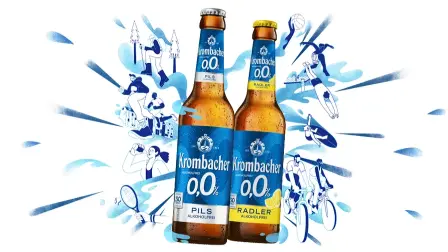
Krombacher is betting more and more on non-alcoholic alternatives. (Image: © Krombacher)
The Krombacher Brewery is consided to be a pioneer in the "non-alcoholic alternatives" segment and offers much more than merely a classic pilsener. Alongside non-alcoholic beer, Fassbrause, malt beverages and Krombacher Spezi also belong to the portfolio that enjoys growing popularity.
"Of course, with around a 50% share of production, our Krombacher pilsener is still our flagship," said Peter Lemm. "But today non-alcoholic and alcohol-reduced varieties like our shandy are important growth drivers for the future."
Whereby at Krombacher alcohol-free is not a product of coincidene, but indeed high-tech brewing art. Two methods are combined for the non-alcoholic pilsener: Interrupted fermentation and a gentle dealcoholisation process. The result: Full taste without alcohol.
"A lengthier process, yes - but one that fulfils our expectations regarding quality and taste," explained Lemm.
The beverage industry facing radical change
The development is not restricted to Germany. The interest in non-alcoholic alternatives is also growing rapidly in other countries too. Lemm reported that Krombacher is noticing this from the exports of Krombacher o.0% for instance. At the same time, new global product categories are evolving with intense, novel taste experiences, such as aromatised types of water, fermented teas or botanic Spritz alternatives.
The challenge for the industry: Fulfilling the growing expectations regarding quality and innovation. Whereby this doesn't just apply for the technology, but also for the industry's values: Sustainability, naturalness and a clear brand positioning are more important than ever when convincing new target groups.
Anuga as a stage for alcohol-free innovation
This year, Anuga will demonstrate how versatile non-alcoholic beverages can be today and how dynamically the segment is further developing. It is no longer a niche market, it is a mass-market with true potential for innovation. From 0.0% craft beers and functional drinks, through to non-alcoholic premium spirits, the offer of new, alcohol-free alternatives is wider and of higher quality than ever before.
Conclusion: Non-alcoholic alternatives have come to stay
The market for non-alcoholic alternatives is not a hype, it is part of a long-term societal change. The combination between lifestyle, health awareness and the joy for innovation is creating scope for new brands, products and consumption occasions. For established manufacturers like Krombacher this is an opportunity - but also a clear mandate. Companies that unite quality, variety and high values, can position themselves as a relevant player in a growing segment, inspire new target groups and at the same time make an active contribution to more conscious consumption.
Anuga and Anuga Hot Beverages 2025 at a glance
In the scope of Anuga 2025 from 4 to 8 October, the trade shows Anuga Drinks and Anuga Hot Beverages will present the current developments of the international beverage industry. The focus lies on innovations in the sections non-alcoholic refreshment beverages, functional drinks, fermented and plant-based beverages as well as concepts for hot drinks such as coffee, tea and cocoa.
A wide spectrum of new products, including modern recipes, sustainable packaging solutions and advanced technological manufacturing methods will be showcased. The two segments thus serve as key platforms for the growing diversity in the global beverage world.
Author
Sanja Wisniewski

